
Disclaimer: This material may include theoretical assumptions, estimates, and speculation and is provided for informational purposes only.
Enterprise audit
Results within 13 months, or receive a full refund.
Request an enterprise audit covering advanced technical SEO audits, AI visibility, authority signals, content architecture, and conversion opportunities.
In May 2024, I brought thousands of pages of Google’s accidentally exposed Content Warehouse API documentation to the court of public opinion. The material gave the public an unprecedented view of internal Search architecture: more than 2,500 pages describing 14,014 attributes, according to Fishkin’s account of the disclosure. Google later confirmed that the documents were authentic while warning that they were incomplete and lacked context.
It did not give us Google’s source code. It did not reveal a complete ranking formula. It did not tell us the current weight of every field, nor the curve.
That distinction matters. As the person who helped open this black box, I have a responsibility not to replace Google’s opacity with SEO mythology.
But restraint does not mean silence. The documents, Google’s own public guidance, court records and the experiences of publishers together expose a serious accountability gap. Google can represent sites at a site-wide level, connect queries to documents through large-scale interaction data and make ranking decisions that erase most of a publisher’s distribution. Yet the affected business is usually shown no meaningful diagnosis, confidence score, failing feature family or route of appeal.
For a company powerful enough to determine which voices are discovered, “trust us” is not a sufficient system of governance.
The Intro
Google launched the Helpful Content Update in August 2022. It described an automated machine-learning classifier and a new site-wide signal. Google said that when a site contained a relatively high amount of content it considered unhelpful, other pages on the same site could also become less likely to perform well. The classifier was weighted and could remain applied for months, according to Google’s original announcement.
The system expanded through later releases. The September 2023 update introduced what Google called an improved classifier. In March 2024, Google incorporated helpfulness into its broader core-ranking architecture and said there was “no longer one signal or system” doing the work. Its current ranking-systems guide now lists the standalone Helpful Content system as retired and says its ideas became part of Google’s core ranking systems.
The label sounded reassuring. Who could oppose helpful content?
But “helpful” is a conclusion, not a measurable explanation. A moralized name can make an automated judgment feel self-justifying: if a page fell, perhaps it was simply unhelpful. If a publisher objected, perhaps the objection proved they were writing for rankings rather than people.
That framing concealed the real technical questions. What did the system observe? At what level did it aggregate evidence? How did it treat uncertainty? Which errors were more costly? Did prior popularity make a site easier to classify confidently? Did the system distinguish a specialist answering many closely related questions from a doorway operation manufacturing pages for query variants?
Publishers were asked to diagnose themselves without being shown what the machine had diagnosed.
What the leak actually shows
The safest conclusion is narrower than many headlines suggested, but it is still important.
In the leaked QualityNsrNsrData schema, Google documented:
titlematchScore: a site-level score describing how well page titles matched user queries.site2vecEmbeddingEncoded: a compressed mathematical representation of a site, intended for a system called “superroot.”- Other site-level fields covering impressions, Chrome views, link-based connections, and quality signals.
This shows that Google designed systems capable of storing a site-wide picture of query-to-title alignment alongside other information about the site.
It does not reveal:
- The exact calculation or threshold.
- Whether a high
titlematchScorehelped or hurt. - How much weight the field received.
- Whether it is currently used in production.
- Whether popular brands received special treatment.
- A direct connection to the Helpful Content classifier.
The calculation in plain English
Think of it like calculating a school grade in which larger assignments count more.
For each search query and page:
- Compare the query with the page title.
- Decide how closely they match.
- Give more importance to query-page pairs with greater exposure, such as more impressions.
- Combine the results into one site-level title-alignment score.
The leaked material does not tell us whether Google used this exact calculation. It is only a simple audit model for understanding the idea.
Example: ten exact-match titles
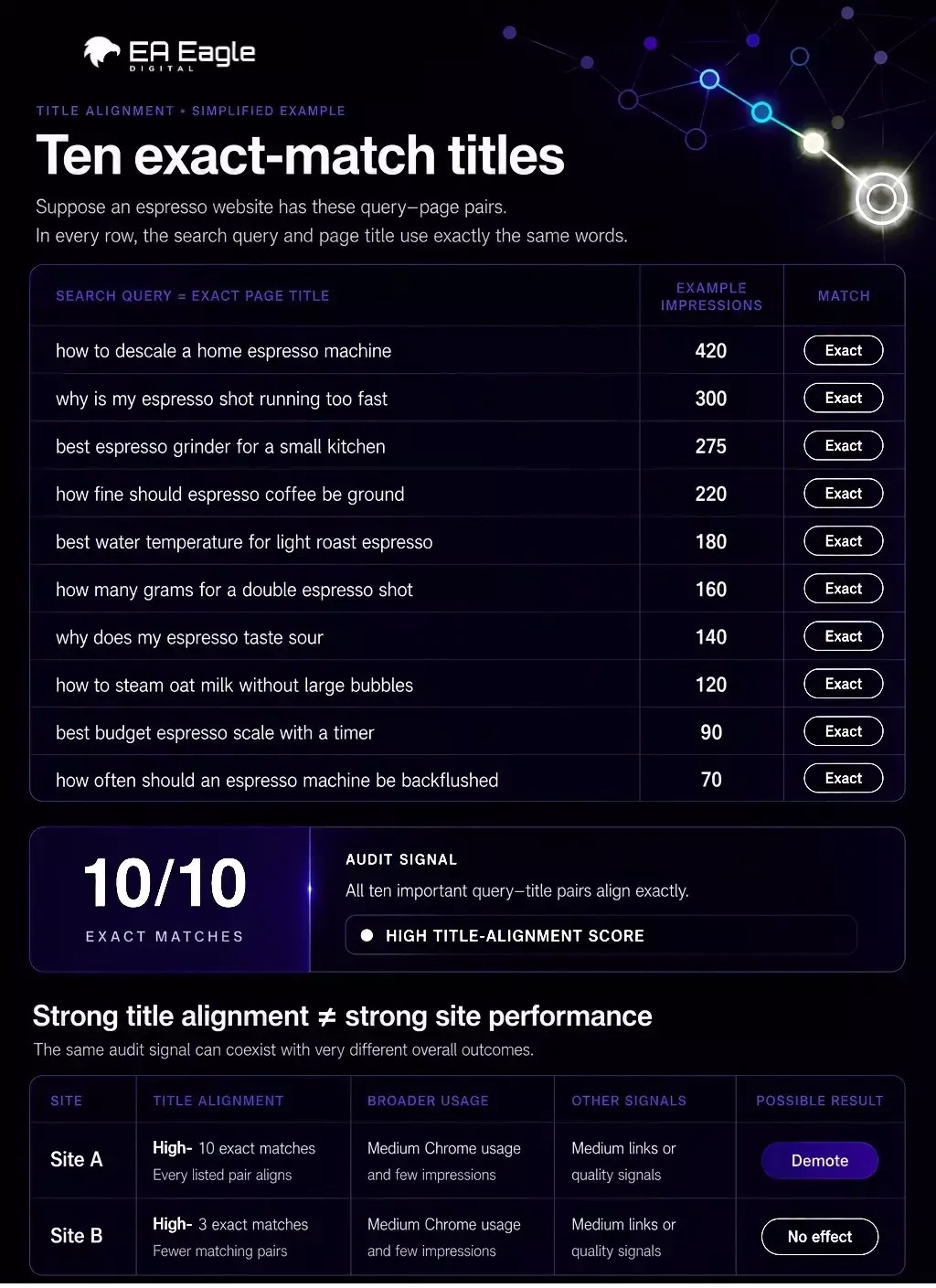
Suppose an espresso website has these query-page pairs. In every row, the search query and page title contain exactly the same words.
In this simplified example, all ten important query-title pairs match exactly. That would produce a high title-alignment score in our audit model.
However, it would not necessarily produce a high overall site score.
These outcomes are examples, not conclusions. Because the real weights and directions are unknown, a high title-alignment score could coexist with either a low or high overall site score.
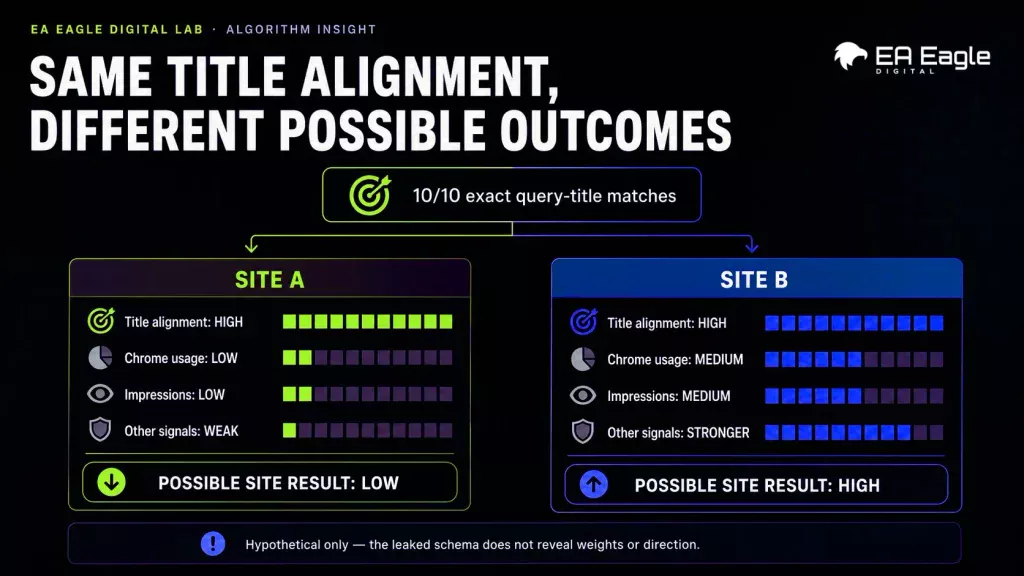
It is that site-level query-title patterns were concrete enough to be named, stored, and potentially considered alongside other host-level information.
Enterprise audit
Results within 13 months, or receive a full refund.
Request an enterprise audit covering technical SEO, AI visibility, authority signals, content architecture, and conversion opportunities.
Implicit Big Brand Protection is There (Sort of)
I have seen no evidence of a literal switch called bigBrandBoost, and the leak does not prove that large brands were exempted from Helpful Content.
Brand advantage can emerge without either.
The public record in United States v. Google describes Navboost as a ranking model trained on 13 months of Google click-and-query data. The court record explains that this data associates queries and results with interactions such as clicks and other aspects of a user’s journey. In the 2025 remedies opinion, the court called this data central to Google’s scale advantage; the underlying 2024 liability findings are summarized in the court’s published opinion.
This proves that query–document interaction data influences Search. It does not prove that Navboost and host-level click data constituted the Helpful Content system. It’s important to note that, in this article, I aim to distinguish between title/query click patterns and satisfied users.
A heavily SEO-optimized site even one with a substantial number of satisfied users may be pushed down if a large proportion of queries related to the site are SEO-focused.
An established brand often receives navigational searches, repeat visits and clicks across many related formulations. A small publisher dependent on a narrow group of non-brand queries has less evidence and more variance. The system can therefore become more confident about the entity it already knows.
Google’s own site-reputation-abuse policy reinforces the structural point. The policy says third-party content may rank better when placed on a host with already-established ranking signals. Google created the policy to stop that abuse, but the wording is also an acknowledgement that host-level reputation can confer an advantage.
None of this proves malicious intent. It supports a testable concern: ranking systems can confuse already recognized with more helpful, even when no engineer explicitly instructs them to favor famous brands.
Google’s Guidance Trap: Advising Publishers to Use Descriptive Match Titles to User Queries
For years, Google told publishers to make pages clear and intelligible to searchers. In 2012, it advised site owners to write unique, descriptive page titles. Its current title guidance says titles should be descriptive, concise and distinct.
Google’s people-first documentation also says SEO can be useful when applied to content made for people.
Then, in March 2024, Google warned that unhelpful pages could include sites created primarily to match very specific search queries.
The conceptual distinction is legitimate. A strong page can answer a specific question; a doorway page can exist merely to intercept the wording of that question. Accurate titles are not the same as mass-producing thin variants.
The failure is operational. Search Console does not show a publisher a helpfulness score, an affected directory, a failing feature family, a confidence interval, a false-positive estimate or a formal appeal route for an ordinary core-ranking loss. Google offers broad self-assessment questions about originality, expertise and reader satisfaction. Those questions can improve editorial discipline, but they are not diagnostics. Several conscientious reviewers can answer them differently, and none can see what Google’s systems inferred.
Manual spam actions at least come with notices and a reconsideration process. A core-ranking reclassification can be just as economically destructive while remaining far less contestable.
Helpful For Whom?! Traffic is Payroll, Rent and Food (and Survival)
We should not exaggerate. The evidence does not prove that Helpful Content was designed to destroy small publishers, but it well did.
HouseFresh, an independent air-purifier testing publication, reported that daily Google visitors fell from roughly 4,000 to about 200 after the September 2023 period. The team described the effect on revenue, staffing and its ability to continue testing products in its first-person account. HouseFresh later reported substantial recovery in 2025 after two years of continued work and changes in Google’s results. That recovery is welcome. It does not make the intervening damage imaginary; it demonstrates how long a correction can take.
Canadian financial-technology company Hardbacon presents an even harsher case. Its chief executive said the business lost 97% of its Google traffic after the September 2023 update. The company cut staff and moved toward bankruptcy. By the time some traffic returned, he said it was too late, according to BetaKit’s reporting.
Google Does Engineer Skin-Tone Diversity In Image Search, but Demotes Smaller Publisher For Bigger Brands
Google does not lack ethics specialists. It has dedicated Responsible AI and Responsible Innovation teams, multidisciplinary reviewers, published principles, governance processes and internal training. A Google Research paper describing the company’s “Moral Imagination” program says it was developed through 70 workshops over four years. Google’s current AI principles emphasize human oversight, feedback mechanisms, testing, monitoring and safeguards against unfair bias.
But neither an ethics team nor an engineering team gets to define “ethical” merely by publishing principles, holding workshops or producing presentations. Ethics is demonstrated by what a company measures, which harms it treats as important, how it explains consequential decisions and what it does when its systems are wrong.
Google’s work on skin-tone representation provides a concrete comparison. In 2022, Google announced that it was using the Monk Skin Tone Scale to improve computer-vision evaluation, add skin-tone filters for some Google Images searches and show a greater range of skin tones in broad image results. It also said the scale would help its systems better detect and rank images for more representative results. Those changes addressed a genuine representational failure, and that work should not be dismissed or reversed. Google explains the initiative in its announcement on improving skin-tone representation across its products.
Human diversity is not limited to the skin tones of the people pictured in a result. It also includes the diversity of people and organizations able to create knowledge, reach an audience and earn a living from their work. A results page can display a visually diverse set of faces while the underlying sources become less plural, less independent and more concentrated among a small group of powerful hosts.
Diversity in the people shown by Search matters. So does diversity in the people allowed to build a livelihood by supplying Search with answers.
When a core update may disproportionately remove small specialist publishers from view while established hosts retain or gain exposure, that is not automatically proof of political bias or deliberate brand protection. It is, however, an allocative-fairness question that Google has the data and expertise to investigate. Its own researchers already recognize that systematic under-exposure of producers can withhold economic opportunity.
Google announced that its March 2024 work reduced low-quality, unoriginal content by 45% based on its own evaluations. I’d aruge, it reduce the food on the table by 50%, which might be something to messure.
What Legislators Should Understand
This is not a demand that every website receive traffic. Search engines must rank, exclude spam and make difficult relevance decisions. Publishers have no entitlement to a permanent position.
The public-interest question is different: what obligations should attach when one private discovery system can make unreviewable, site-wide judgments with economy-shaping effects?
In August 2024, a federal court concluded that Google unlawfully maintained monopolies in general search services and general search text advertising. The remedies process later addressed the scale advantage created in part by Google’s distribution arrangements and its enormous stores of query and interaction data. The Justice Department summarizes the finding and subsequent remedies in its case announcement.
Legislators and regulators should therefore ask for:
- independent, repeatable audits of ranking exposure by publisher size and business model;
- documented governance separating organic-quality decisions from short-term advertising pressure;
- retention of the evidence needed to investigate major ranking incidents;
- standardized notices for severe automated distribution losses;
- a meaningful human-review process for catastrophic outliers; and
- researcher access to privacy-protected data sufficient to test concentration and feedback effects.
The antitrust record also revealed internal concern about the boundary between Search and advertising, including a 2019 email from then-Search chief Ben Gomes entered as trial exhibit UPX2044.
In the February 2019 email, then-Search chief Ben Gomes explicitly warned fellow executives that Google Search was “getting too close to the money” and becoming too involved with advertising growth at the expense of user experience.
Enterprise audit
Results within 13 months, or receive a full refund.
Request an enterprise audit covering technical SEO, AI visibility, authority signals, content architecture, and conversion opportunities.
The editorial team