

Enterprise audit
Results within 13 months, or receive a full refund.
Request an enterprise audit covering advanced technical SEO audits, AI visibility, authority signals, content architecture, and conversion opportunities.
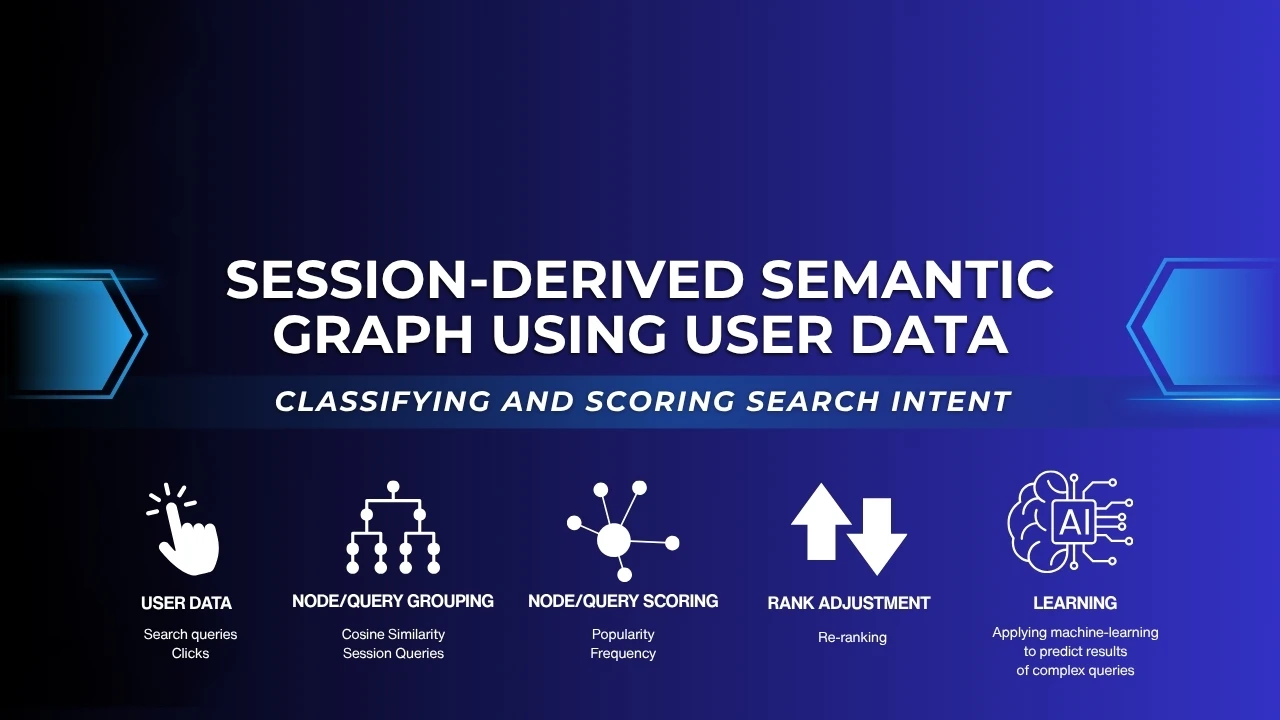
Session-Derived Semantic Graph for Semantic-like SEO Optimization
This article develops that idea as a session-derived semantic graph for Semantic SEO Frameworks. It explains a plausible architecture, proposes scoring functions, shows how dense embeddings and seed sets could generalize beyond exact query–document pairs, and examines use cases from tail-query retrieval to entity discovery and quality scoring.
A search engine never sees intent directly. It sees evidence: a few words, a device and locale, a ranked page of results, a click or no click, a return to the results, and perhaps another query. The engineering challenge is to turn those fragments into a probabilistic answer to a deceptively simple question: What is this person trying to accomplish with this query?
The answer rarely lives in the query alone. It emerges from the query’s neighborhood – the searches that came before it, the refinements that follow it, the documents selected along the way, and the amount and pattern of attention those selections receive. At scale, those journeys become maps connecting queries, intents, and documents.
That is the useful way to think about session queries and systems such as Google’s Navboost: not as a machine reading a user’s mind, and not as a crude vote counter, but as a set of mechanisms that learn from repeated search behavior while correcting for the many reasons behavior can mislead.
Raw Query Phrases Reveal Little Context or Intent
Consider the query jaguar.
It could refer to an animal, a carmaker, a sports team, an operating system, or something else. The query itself doesn’t provide match context with regards to the user intent, but the user data will.
Language models, entities, location, freshness, and document content can all help disambiguate it.
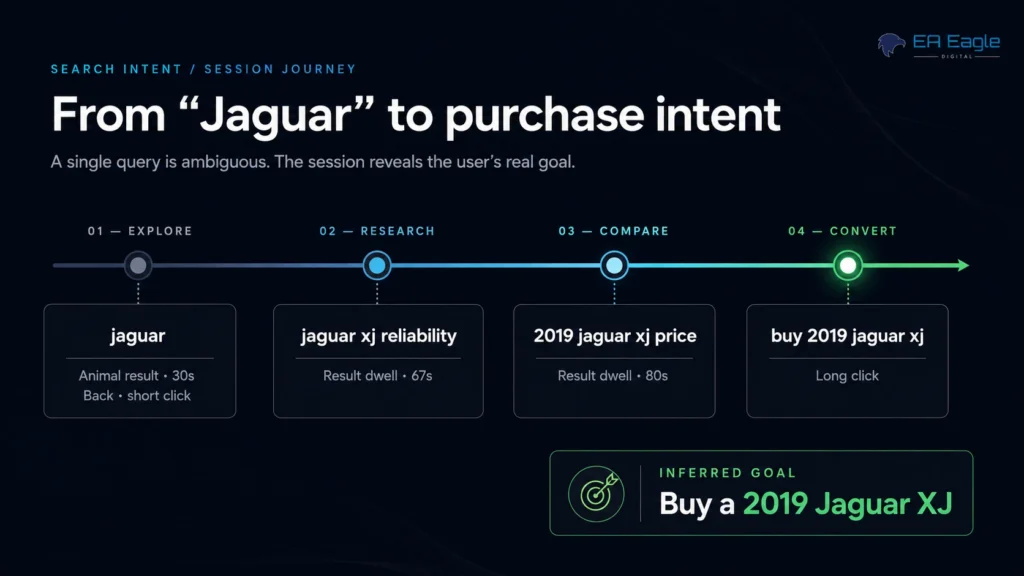
But a short search sequence can make the intended meaning much clearer:
Jaguar
Session Started
jaguar xj reliability
User reforming the query
2019 jaguar xj price
Final Destination
The first query is ambiguous. The sequence is not. The later queries reveal that the user is researching a particular car, while the click supplies a query-to-document association. In another session, jaguar habitat followed by amazon jaguar population would pull the same opening word into an entirely different intent cluster.
This is why a search session is more than a timeout window. In the simplest implementation, it is a sequence of queries and interactions from the same user or browser identifier within a period of time. More sophisticated sessionization also considers topical continuity, because a fixed cutoff can split one long research task or merge two unrelated tasks.
A Google patent on determining intent from query patterns describes sessions containing multiple queries, clicks, view time, and even a lack of interaction; it also describes using additions and removals of terms across refinements to infer intent.
The design is illustrative rather than proof of current production behavior, but it captures the enduring principle: a sequence reduces ambiguity that no single query can fully resolve.
Previous Queries and Future Queries Play Different Roles
The phrase future query needs care. At the moment a search engine serves the first query, it cannot know what the user will type next. Future queries can influence understanding only after they occur.
That creates two distinct uses of session data.
Previous queries provide live context
Queries already issued in the current session can help interpret a new, elliptical search. After Golden Gate Bridge year built, a query such as where is it can be rewritten as an explicit question about the Golden Gate Bridge. A Google patent on session-based query rewriting describes generating and scoring candidate rewrites from prior queries, with newer context weighted more heavily than older context.
This is real-time context: the history exists before the current result set is produced.
Subsequent queries provide retrospective labels
Later queries are valuable offline. They show how the user refined, corrected, narrowed, broadened, or abandoned an earlier formulation. Across many completed sessions, search engines can learn transition patterns such as:
- misspelling -> corrected spelling;
- broad topic -> specific entity or attribute;
- informational query -> comparison query -> transactional query;
- ambiguous term -> disambiguating modifier;
- failed formulation -> successful reformulation.
Those transitions can train models, build query graphs, improve spelling and synonym systems, and generate related searches for future users. The 2024 decision in United States v. Google specifically notes that user data helps Google identify misspellings and query reformulations.
The key distinction is temporal: prior queries may affect the present search directly; subsequent queries teach the system how similar searches should be understood later.
How a Session Becomes an Intent Map
A completed search journey can be represented as a graph with several kinds of edges:
Query -> query: the user reformulated one query into another.
Query -> document: the user selected a result for that query.
Document -> query: many users reached the same document through different queries.
Query -> outcome pattern: the user stopped, returned quickly, continued deeper into the site, or issued another search.
Each edge has a strength rather than a binary meaning. Frequency, recency, rank position, device, locale, and interaction pattern can all change its weight.
There are two especially useful ways to connect queries.
Session Co-Occurrence
If users repeatedly issue query B after query A, the transition suggests a relationship. A later query might be a refinement, a correction, a next step, or a change of topic, so systems must estimate both transition strength and topical continuity.
One Google patent describes parent-child query relationships derived from successive queries in a session, then uses shared parents to identify “sibling” refinements. In plain English, if many people move from the same broad query to several different specific queries, those children may represent alternative aspects of the same underlying need.
Co-click Similarity
Two queries can also be related when they lead users to the same documents. A query-document graph therefore creates a second path between queries: query A -> document X <- query B. A Google patent describes query-document-quality tuples and a map in which queries and documents are connected through user preference data.
The strongest systems combine these views. Google researchers reported that clustering query refinements with both document clicks and session co-occurrence produced better user-rated intent clusters than using either source alone. This matters because the two signals compensate for each other’s weaknesses: query transitions expose the user’s path, while shared documents expose semantic overlap even when the wording differs.
Related Queries are Compressed Search Journeys
What users see as related searches or query suggestions can be understood as a compressed summary of many earlier journeys.
Suppose thousands of sessions begin with home espresso machine and continue toward best espresso machine under 500, espresso grinder, semi automatic vs automatic, and breville barista express cleaning. A related-query system can estimate which transitions are common, useful, diverse, and appropriate for the current context.
The objective is not simply to display the most frequent next string. Good suggestions should cover distinct intents, avoid redundant phrasings, remain safe and fresh, and lead to useful result sets. A popular transition may be a spelling correction; another may represent a minority intent worth surfacing; another may be an unrelated topic switch that should be discarded.
This also explains why related-query systems and ranking systems overlap without being identical. Both can use session and click evidence, but one selects or organizes queries while the other scores documents. A transition graph can inform both: it may propose the next query to the user, or help the engine reinterpret the current query before retrieving and ranking documents.
What Clicks Actually Tell a Search Engine
A click is an observable choice under a particular presentation. It can suggest that a result looked promising, but it does not by itself prove that the document satisfied the need.
The click sits inside a richer event record:
- the query and any session context;
- the result’s URL, title, snippet, feature type, and rank;
- which results were shown but not selected;
- the timing and order of clicks;
- whether the user returned to the results;
- what the user clicked or queried next;
- device, locale, and other permitted contextual attributes.
Duration can add useful information. Patents describe classifying longer and shorter views or treating a quick click-through reversion as evidence that a result underperformed The attached 2006 Google presentation on query-specific recommendations likewise lists clicks, refinements, history matches, session duration, and long clicks among signals for assessing whether a query reflected a continuing interest .
But dwell time is not a universal satisfaction score. Ten seconds may be excellent for a weather lookup and poor for a long tutorial. A user may leave a useful tab open while doing something else, copy an answer immediately, complete a task without returning to search, or abandon the device. This is why robust systems compare behavior within query, task, device, locale, and presentation contexts instead of applying a simplistic rule such as “longer is always better.”
The sequence after the click often supplies the missing semantics. A quick return followed by a click on another result can indicate mismatch. A return followed by a narrower query may indicate partial progress rather than failure. No return may indicate success, distraction, or task abandonment. Meaning comes from patterns aggregated over many journeys, not from a single stopwatch reading.
Why Raw Click-Through Rates Are Really NOT A Ranking Factor
Click data is abundant, but it is biased.
First, users examine higher-ranked results more often, creating position bias. Second, they choose from a summary rather than the full page, creating presentation bias. The attached Google study by Yue, Patel, and Roehrig controlled for position and human-rated relevance and still found that an additional bolded query term in a title increased click odds by roughly 16 percent in its rated model. In other words, a result can attract clicks because its search snippet looks more relevant, even when human judges do not prefer the underlying page.
Navigational queries create another distortion: one site may deserve an overwhelming share of clicks because users are trying to reach it. Brand familiarity, rich-result formats, screen layout, answer boxes, and result freshness can all alter click propensity independently of document quality.
Consequently, a serious click system must normalize, stratify, experiment, or model around presentation effects. Raw CTR is not a portable page-quality metric. At most, it is one observation about a query-document-result presentation under specific conditions.
Navboost: Query-Document Memory
Navboost moved from industry speculation into the public record during the U.S. search antitrust litigation.
The court’s 2024 findings describe Navboost as a signal that pairs queries and documents by memorizing user click data. The opinion says it helps Google remember which documents users clicked after a query and identify when one document receives clicks from multiple queries. It also states that Google had used a 13-month data window since 2017, after previously using 18 months.
Pandu Nayak’s trial testimony adds useful boundaries. He described Navboost as a core system dating to around 2005 or earlier, said it memorizes past clicks for past queries, and confirmed the 13-month window. He also emphasized that it is one factor among many in reducing a large candidate set to a smaller set for later ranking stages.
That public evidence supports four important conclusions:
Navboost is query-specific. Its useful unit is not “this page has engagement” in the abstract, but evidence connecting queries and documents.
It is aggregated memory, not a live mind reader. Historical behavior informs later retrieval and ranking.
Context changes the memory. Testimony says Navboost slices data by locale and by mobile versus desktop, reflecting differences in meaning and intent.
It is not the whole ranking system. Content, topicality, quality, links, freshness, location, language understanding, and other systems still matter. The court described newer generalization systems as filling holes where click data is sparse.
The same testimony distinguished Navboost’s focus on web results from Glue, described there as a related signal for other features on the search results page. The terminology and implementation may evolve, but the conceptual division is useful: behavioral evidence can influence both the selection of web documents and the composition of the broader results page.
What the record does not justify is the claim that Navboost is merely raw CTR, that every long click produces a fixed ranking boost, or that a single user’s behavior directly moves a page. The evidence points to large-scale, query-linked aggregation used alongside many other signals. The bias research explains why anything simpler would be unreliable.
The Practical Lesson for Marketers and SEOs
The strategic takeaway is not “manufacture clicks.” It is to make a page the most satisfactory continuation of the search journey it actually serves.
Intent fidelity comes first: titles and snippets should accurately promise what the page delivers. Clicks won through exaggeration can create return-and-reformulation patterns that reveal a mismatch.
Optimize for task completion, not generic time on site. A definition may succeed by answering immediately; a comparison needs clear criteria and evidence; troubleshooting content should expose the diagnosis and steps without forcing an essay. The next queries in real journeys also reveal adjacent needs – comparisons, alternatives, constraints, risks, and follow-up actions – that can guide useful information architecture.
Useful questions for publishers include:
Does the page answer the dominant interpretation of the query immediately?
Does it make important sub-intents easy to locate?
Do the title and snippet set an honest expectation?
Can users complete the likely task without returning to search for missing basics?
Are distinct intents served by distinct pages where appropriate, rather than one page trying to rank for incompatible needs?
Do internal links follow the natural next questions users ask?
These improvements align with the purpose of session and click models: identifying results that consistently help searchers progress.
Search intent is not always a label attached to a query string. It is often a trajectory that becomes visible only as the user acts. Previous queries provide immediate context; subsequent queries reveal refinements and become retrospective training evidence. Clicks connect queries to documents, while duration and returns add weak, task-dependent clues. Related-query systems compress recurring paths into suggestions and clusters. According to the court record, Navboost operationalizes query-document click memory at enormous scale for Google’s web results.
No signal is trustworthy alone. After accounting for position, presentation, task, device, locale, freshness, and sparse data, the combined evidence helps a search engine move from matching words to modeling needs.
Integrating LLM-Derived Natural Language Processing into Session-Derived Semantic Graph for Understanding Complex Queries
Classical web search treats relevance as a relationship between a query and a document, moderated by:
- Per Document-based Signals: Links, PageRank, Anchor Text, Popurality, Spam Signals
- QSR (Query-Specific Recommendations): Query specific signals, using counts and frequency and categorization of click and query logs.
- Site-Level Signals (NSR)
A richer system could also infer user intent, derive context from a set of queries, learn from click data, and apply those insights more broadly to queries with little historical data. That is essentially what RankBrain did. But you could do something similar without RankBrain or machine learning using a technique such as cosine similarity to generalize user-intent data to long-tail queries with little click-related data.
RankEmbed, on the other hand, as I understand it, takes this idea several steps further. It applies BERT-like natural language processing to large samples of user data and uses machine learning to rerank some results based on generalized patterns in searches and clicks. This can have the effect of favoring larger brands because smaller sites with exact-match query–click logs may no longer be able to dominate a handful of queries. More broadly, however, it seeks to understand queries by learning the relationships among words and contexts across a large dataset.
Such training data could include signals from user journeys: sequences of queries and clicks, pages visited, dwells and hovers over search results features (WebAnswers, FAQ, etc), links opened, searches and query reformulations, short and long clicks.
In such a system, a visit would not merely represent traffic. Under strict aggregation and debiasing, repeated transitions could provide weak evidence that two entities, concepts, queries, or passages belong to the same latent task.
This hypothesis also draws a firm epistemic boundary. Public records support the existence of click-informed and embedding-based ranking components, but they do not establish that Google globally converts an individual’s complete Chrome history, passage-level scrolling, or cross-product account activity into the specific ranking mechanism modeled here.
The result, therefore, is neither an exposé nor a claim of privileged knowledge. It is a technically grounded hypothesis about what a modern search system could do and why doing it reliably would be much harder than simply counting clicks.
Topicality Vector Embedding and Quality Priors
Any serious analysis must separate four categories:
- What is publicly documented,
- What is supported by litigation evidence
- What is technically plausible
- What remains unverified
Collapsing these categories produces a seductive but scientifically weak story.
Google’s public ranking-systems guide says that BERT helps interpret how word combinations express meaning and intent.
Neural matching relates representations of concepts in queries and pages; passage ranking identifies relevant sections within pages; and links and clicks remains part of core ranking systems.
Google publicly announced the application of BERT to ranking in October 2019 and described it as especially useful for longer queries whose meaning depends on context.
The underlying BERT research appeared in 2018 and at NAACL 2019.
Publicly filed exhibits in the United States antitrust litigation add a more granular, though still incomplete, view.
One exhibit summarizes Navboost as a query–document table containing frequencies of user query activity by document. Former Google engineer Eric Lehman described it in testimony as an aggregated table of clicks for query–document pairs, with additional data, rather than a machine-learning model.
A separate exhibit describes RankEmbed as a dual-encoder model that maps query and document into an embedding space and scores them by a dot product; it also describes DeepRank as BERT-based.
What the public evidence does not demonstrate is equally important. It does not show that a rendered title is universally “pinged” from Chrome into a global ranking graph; that hovering or scrolling over a paragraph creates an immediate semantic fact; or that a single account’s path directly causes a person, phrase, and page to become associated for everyone. Google does say that, when users enable the relevant controls, Web & App Activity can include synced Chrome history and activity from sites and apps using Google services. Collection, personalization, service improvement, model training, and general web ranking are nevertheless different purposes. Evidence of one is not proof of the others.
From the Click Counts to Mapping User Browsing Journey
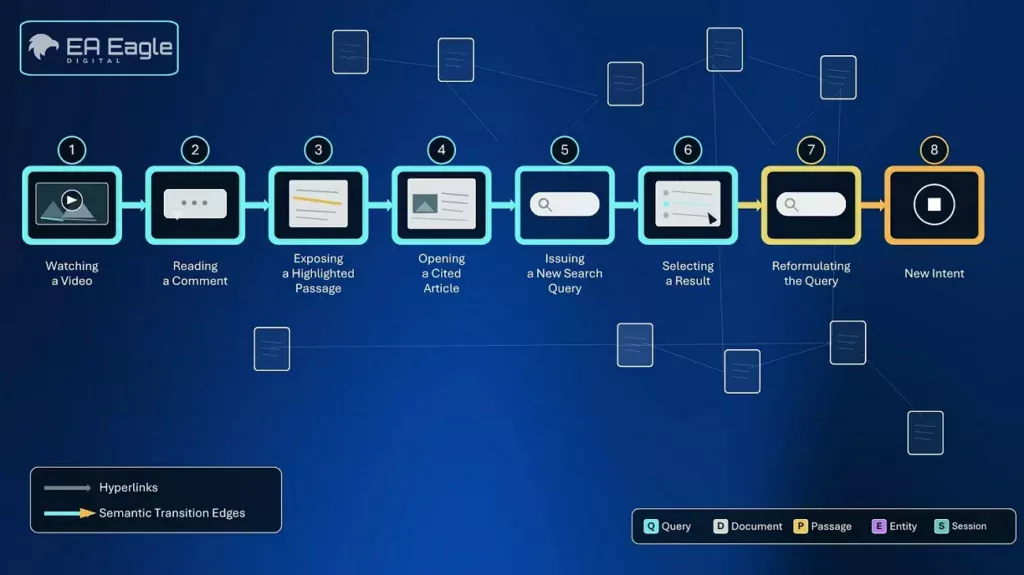
PageRank’s conceptual object is a graph whose nodes are documents and whose edges are authored hyperlinks. The proposed system adds a second graph whose edges are observed transitions. A user watches a video, reads a comment, exposes a passage, opens a cited article, later issues a query, selects a result, reformulates the query, or stops searching. These events form a path through an information space.
Let the heterogeneous node set be
V = Q ∪ D ∪ P ∪ E ∪ S,where Q denotes queries, D documents, P passages, E entities or concepts, and S session states. Edges are typed: issued-after, clicked-from, linked-to, passage-exposed-before, reformulated-as, returned-from, and co-consumed-with. An authored hyperlink says, “this source intentionally points there.” A behavioral transition says something weaker: “within this task, people repeatedly moved from here to there.”
Calling both relationships “links” invites confusion. A better term is a semantic transition edge. It is not an inbound link in the PageRank sense, and it is not automatically an endorsement.
It is a probabilistic observation that two objects may help satisfy the same need. The central research question is whether many noisy journeys, aggregated across users and corrected for exposure bias, reveal intent that page text and authored links alone cannot.
End-To-End Mechanism
Event construction. The system receives permissible interaction events with timestamps, surfaces, device classes, coarse locations, and consent states. Search-result impressions and clicks are comparatively direct. Watch time, page transitions, and scroll depth are more ambiguous: a long dwell can mean satisfaction, confusion, distraction, or an abandoned tab. Raw events are therefore observations, not labels.
Sessionization. Events are grouped into latent tasks. A fixed thirty-minute timeout is convenient but crude: research tasks span days, while unrelated actions can occur seconds apart. A stronger model estimates the probability that two events belong to the same task from temporal distance, semantic similarity, referrer structure, account continuity, and changes in intent. It should also permit one session to contain several concurrent tasks.
Weak-label generation. A transition receives a provisional weight based on its event type and context. A deliberate click on a citation is stronger than merely scrolling past it; a later navigational query is stronger than a transient hover; repeated independent paths are stronger than a single path. Returns to the results page, reformulations, and subsequent selections can supply negative or contrastive evidence, but none has a universal interpretation.
Representation learning. A dual encoder maps queries and documents into vectors for fast retrieval. A passage encoder maps salient spans; a session encoder summarizes recent task context; and an entity linker maps names and phrases to candidate entities. Training can combine explicit relevance judgments, aggregated behavior, hyperlink context, and contrastive negatives. Unlike a query–document count table, embeddings can transfer evidence from a frequent head query to semantically adjacent tail queries.
Retrieval and reranking. At query time, lexical systems first preserve exact names, rare tokens, dates, and negation. Approximate nearest-neighbor retrieval adds semantically close documents. A more expensive cross-encoder or feature-based ranker then combines topicality, behavioral aggregates, quality, freshness, locality, diversity, and safety. Session context may affect personalization or query interpretation, while population-level aggregates may affect general ranking. Those are distinct channels and should be audited separately.
Enterprise audit
Results within 13 months, or receive a full refund.
Request an enterprise audit covering technical SEO, AI visibility, authority signals, content architecture, and conversion opportunities.
Scoring User Intent Without Mistaking Engagement for Authoritativeness/Quality
The simplest behavioral system is a table.
For query q and document d, let n(q,d) count qualifying clicks in a retention window. A smoothed navigational score might be
N(q,d) = log(1 + n(q,d)) · R(q,d) · B(q,d),where R discounts old observations and B corrects known biases. This resembles the publicly described query–document character of Navboost, but it is intentionally generic; the actual production formula is not public.
Raw counts are inadequate. Rank position determines visibility, attractive snippets alter click probability, browsers and locales are sampled unevenly, and a familiar brand can receive clicks even when a lower result is better.
Google researchers have published work on position-dependent examination and trust bias in learning from clicks, illustrating why a click cannot simply be treated as relevance. A counterfactual correction can weight an observed click by the inverse probability that the result was examined under the logging policy.
Randomized interventions or interleaving experiments give better causal estimates, but at substantial product and ethical cost.
For the journey graph, let an event connect nodes a and b. One possible edge weight is
w(a,b) = Σᵢ ρ(typeᵢ) · exp(−Δtᵢ/τ) · κᵢ · πᵢ⁻¹ · uᵢ,where ρ is event reliability, Δt is temporal separation, τ is a decay scale, κ is cross-source or cross-user corroboration, π is estimated exposure propensity, and u is an abuse- and consent-aware eligibility term. Bayesian shrinkage should pull sparse edges toward a conservative prior; otherwise one person can manufacture a relationship in an empty niche.
Dense relevance is computed independently. Let
zq = fθ(q, h) and zd = gφ(title(d), passages(d), anchors(d)),where h is optional session context. The dense score is D(q,d) = zq · zd, often normalized to cosine similarity. A passage score can use the maximum or a learned aggregation over passage vectors.
A cross-encoder may then examine the query and candidate passage jointly, at higher cost, to resolve compositional details that independent embeddings miss.
A composite ranking function might be written as
Score(d | q,h) = αL + βD + γG + δN + εQ + ζF − λA,- where L is lexical relevance,
- D dense semantic relevance,
- G graph proximity through semantic transition edges
- N query-specific behavioral evidence
- Q a quality prior
- F contextual features such as freshness or locality
- A an abuse, duplication, or safety penalty
The weights need not be global constants; a gating model can vary them by query class. Exact-name navigation may emphasize L and N; an unseen conceptual query may emphasize D; health or civic queries may place a stricter floor under Q.
This separation matters. Quality is not synonymous with popularity, and relevance is not synonymous with satisfaction.
A sensational falsehood can attract long sessions. A definitive answer can produce a very short visit. A trusted encyclopedia may be high quality yet too general for a narrow engineering query. The ranker must model these dimensions separately and combine them under constraints.
Popularity and volume-based metrics can act as multipliers when used alongside quality-based metrics.
How Google May Score Topic Embeddings Using Referral Traffic Data from Chrome: Latent Association Based on User Browsing Journey
Traditional Large Language Models (LLMs) determine topic embeddings purely via textual context windows. However, Google integrates deterministic behavior patterns via Chrome to refine semantic clustering. When users navigate across websites, they forge behavioral links between separate content spaces.
Behavioral Co-occurrence: If users researching “Quantum Computing” frequently jump to a specific vendor’s “Cloud Architecture” page via Chrome, a latent link is established.
Bridging Semantic Gaps: The LLM adjusts its mathematical vector distance. It places these topics closer together in the embedding space. This adjustment occurs even if the pages do not explicitly link to each other textually.
Google’s LLMs utilize latent associations from user browsing journeys to dynamic-score topic embeddings by analyzing referral patterns, session paths, and clickstream sequences. This mechanism bridges raw structural click data with semantic vectors. It evaluates how real human journeys link seemingly unrelated web entities.
How Chrome Referral Data Informs Topic Scoring
Google treats the browser as a data-collection network for lineage-based browsing paths. It builds a directed graph of user navigation across the web.
Lineage Mapping: Chrome tracks derivational relationships when users open tabs from links or enter fresh URLs right after a specific session. This builds hierarchical session data models.
Referral Quality Weighting: Not all traffic is scored equally. Direct search clickthroughs, organic page-to-page referral handoffs, and final conversion endpoints receive distinct signal weights.
Here is an example:
Consider a fictitious creator, Mara Venn, and a newly coined niche term, lattice marketing.
A user watches a video titled “Interview with Mara Venn.”
In a comment, a sentence claims that Venn introduced the term and links to an article titled “How Mara Venn’s Lattice Marketing Changed Community Campaigns.” The user pauses over the relevant passage, opens the article, reads it, and later searches for “Mara Venn.”
A naive system might immediately connect the person to the phrase. A defensible system would treat the path as a bundle of uncertain observations:
- The video title supplies an entity mention.
- The comment supplies a textual claim and a hyperlink edge.
- Passage exposure suggests but does not prove attention.
- The outbound click shows an intentional transition.
- The article title and body supply another co-mention.
- The later query suggests continuing interest in the entity.
The strongest inference is not “the claim is true.” It is “within at least one task, the entity and phrase were jointly salient.” If many independent users follow similar paths; if multiple independent pages make the same association; if their passages are semantically consistent; and if trusted sources corroborate it, the edge can gain confidence. The graph might then help retrieve the article for a tail query such as “who introduced lattice marketing?” or help a semantic model understand why a search for Venn sometimes carries interest in that concept.
Several alternative explanations remain. The user may have searched Venn because the interview was entertaining, not because of the coined term. The comment may be promotional. The article may repeat a false attribution. The title may have changed after the visit. This is why behavioral co-occurrence is best used as a candidate generator, a weak label, or a relevance feature.
Vector embeddings and the Role of Seeds
Count tables memorize; embeddings generalize. If a system has strong evidence for the pair (“Mara Venn,” article A), a dual encoder can place semantically related queries “Venn terminology,” “origin of lattice marketing,” or a misspelled variant near article A even when those exact pairs have few or no clicks. The public description of RankEmbed captures this advantage and its weakness: fast, high-quality matching on common patterns can degrade on tail queries. Rare names, new senses, and adversarial text expose the limits of geometric similarity.
Seeds stabilize the geometry. They may include human-rated query–document pairs, authoritative source sets, high-confidence navigational pairs, canonical entities, known spam clusters, or experimentally validated transitions. Positive seeds pull compatible representations together; hard negative seeds teach the model that lexical or behavioral proximity does not imply relevance. A graph-regularized objective could encourage neighboring nodes to share representations while preserving supervised constraints:
Loss = Lrelevance + μLcontrastive + νΣ(a,b) w(a,b)||za − zb||² + Ωprivacy + Ωabuse.Seeds must be diverse and revisable. A narrow “trusted” set can encode institutional bias, suppress emerging expertise, or turn yesterday’s consensus into tomorrow’s blind spot. The proper role of a seed is to regularize uncertain evidence, not permanently define authority.
Enterprise audit
Results within 13 months, or receive a full refund.
Request an enterprise audit covering technical SEO, AI visibility, authority signals, content architecture, and conversion opportunities.
The editorial team